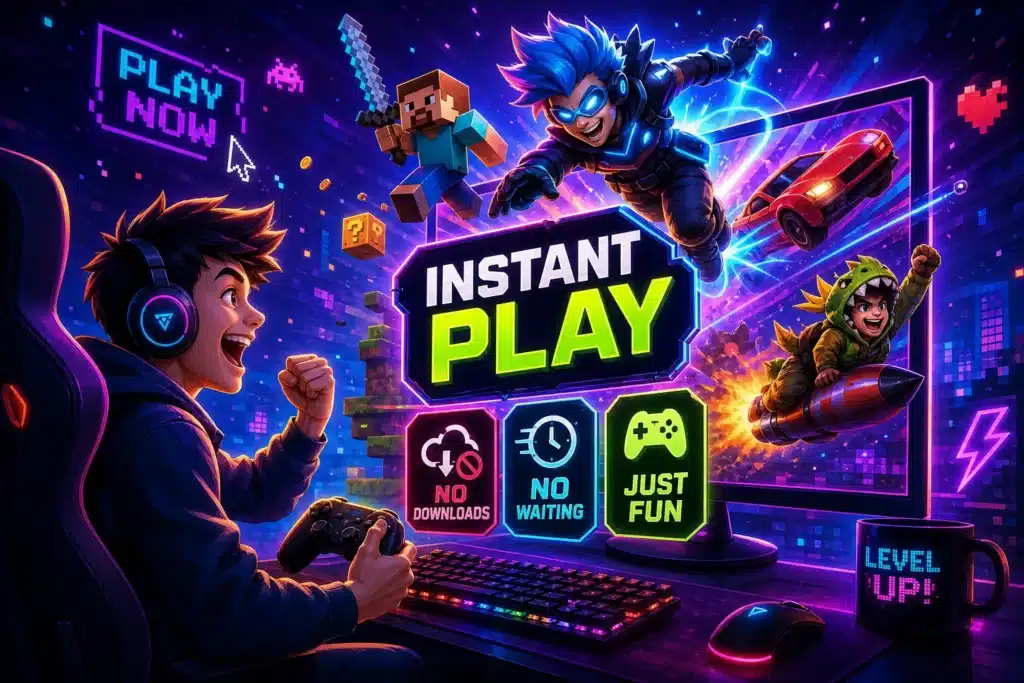
You have ten minutes to kill. You open a game, and six of those minutes vanish watching a progress bar crawl across your screen. By the time the title screen loads, your break is over. That frustration is exactly what instant play games were built to eliminate. These are web games without a download, an app store visit, a permission screen, or an account requirement, you click, and you are playing. Typically, no special hardware or software is needed, though some browser games may request certain permissions or offer optional accounts for saving progress.
The picture around this style of gaming shifted sharply at the end of 2025. Google Play Instant, Google’s Android feature that let users trial apps without a full install, was officially discontinued in December 2025, citing low user engagement and a shift toward AI-powered discovery tools. Rather than leaving a gap, that shutdown clarified something the gaming world had been figuring out for years: browser-native play was always the cleaner solution. Many in the industry saw the shutdown as confirmation that HTML5-powered browser gaming had already become the dominant standard for friction-free play in 2026.
That is precisely the model Hot Games is built around. The platform is designed so that titles load directly in your browser within seconds, on any device, without touching your device’s storage. No friction. Just games.
What Instant Play Games Actually Mean in 2026
The term used to mean a few different things depending on where you encountered it. Google Play Instant was a feature on Android devices (running version 5.0 and later) that let users run lightweight, on-demand app modules without completing a full installation, temporary cached code that ran natively on the device, not a streamed video feed. The “Try Now” button in the Play Store was its most visible face. Useful but limited: Android-only, not universally available across all devices, and a fundamentally different approach than browser-based HTML5 games.
The End of Google Play Instant and What Replaced It
Google pulled the plug on Play Instant in December 2025 (see Google’s original announcement). After that date, developers could no longer publish Instant Apps through Google Play, and all associated APIs stopped functioning. For casual gamers, this was not a loss. It was a clarification.
Browser-based, HTML5-powered gaming had already been the cleaner answer for years. It requires no Android-specific runtime and no app store. It works on any device with a modern browser, including your phone, laptop, or school Chromebook. In 2026, instant play games almost always refer to titles that run directly in your browser. There is no installation step. Just click and play.
How HTML5 Made Browser Gaming Genuinely Good
The browser games that many players remember from the Flash era were clunky, often pixelated, and plagued by crashes. HTML5 changed the quality ceiling entirely. Modern no-install browser games run at your device’s native resolution. They offer responsive controls and polished visuals. Because they render directly on your hardware, performance depends on your device instead of a remote server. This creates a smoother and more consistent gaming experience.
This is why platforms like Hot Games can maintain a full library of genuinely enjoyable titles without asking you to install a single byte. The browser does the work, and the game is ready when you are.
Why Zero-Friction Gaming Changed How People Play
The old gaming ritual trained players to treat sessions as commitments. Download the game, install it, wait for the day-one patch, configure your settings, and then finally play. That cycle made sense for a three-hour RPG session on a weekend. It makes no sense for a ten-minute break between classes or a quick multiplayer round during lunch.
Instant play games broke that pattern by removing every step between “I want to play something” and “I am playing something.” The result was not just convenience, it opened gaming up to audiences who never had the time, the hardware, or the inclination for the full ritual.
The Players Who Benefit Most
Three groups get the clearest value from browser-native gaming, and each for a distinct reason.
Students on shared school Chromebooks often cannot download or install anything, making browser play their only real option for gaming during downtime. The zero-install requirement is not a nice-to-have for them, it is the entire point.
Casual players who want a genuine ten-minute entertainment session during a lunch break need something that starts in seconds and stops just as cleanly. No save-state anxiety, no tutorial to sit through, no lengthy loading sequence eating into limited free time.
Friend groups looking to jump into something together face a familiar coordination problem with downloaded games: someone is always still installing, always on the wrong version. With browser games, one shared link solves it for everyone at once.
The Multiplayer Advantage Nobody Talks About
Instant play particularly transforms social gaming in ways that go beyond simple convenience. When one person shares a link and five friends can be in the same game lobby within roughly a minute, the barrier to spontaneous gaming disappears. There are no “hold on, I’m still downloading” moments, no version mismatch errors, no platform exclusivity problems. Games like Skribbl.io and Bloxd.io let players set up private rooms and share a link, with no account creation required on either end. That is a fundamentally different social dynamic than coordinating a download across five different devices.
Instant Play Games in 2026: A Genre Breakdown
Genre matters more than any ranked list when you are choosing what to play. The right game depends on your mood, your available time, and whether you are playing alone or with friends. Here is how the genre map looks in 2026.
Puzzle and Strategy Titles Worth Your Time
Puzzle and match-3 games consistently lead instant-play charts, and the reason is structural: the mechanics click within thirty seconds, but the depth keeps sessions running longer than intended. Tile-matching, logic puzzles, and spatial challenges are especially well-suited to mobile browsers during commutes because they do not demand precise reflexes or a large screen. Titles like 2048 and Wordle have proven that a great puzzle game needs almost zero visual resources to be completely absorbing. On the strategy side, browser titles like Forge of Empires, which carries a 4.9-out-of-5 rating on several major review platforms, show that genuine depth is achievable without any installation at all.
Arcade and Action Picks for Short Sessions
Fast-paced arcade games are the genre most associated with the “five minutes that becomes thirty” phenomenon. They are designed for short bursts but reward pattern recognition and reflex development, which creates a natural pull to keep going. HTML5 rendering keeps input lag in the 30 to 50 millisecond range on modern devices (see measuring input lag in browsers), which means these games feel responsive and tight even without a dedicated gaming setup. Racing titles like Moto X3M and physics-based action games deliver that satisfying snap that used to require a console.
Multiplayer and .io Games Leading the Pack
The .io genre has been the biggest growth area in browser gaming because it combines zero-friction access with genuinely competitive social loops. Slither.io, Agar.io, Krunker.io, and Smash Karts each offer real-time multiplayer that you can reach from any browser tab without creating a profile. These games match you with other players instantly, so the competitive experience starts the moment you load the page. For friend groups, Doodle Duel supports up to thirty players in a single session on mobile browsers with no signup required.
Browser Instant Play vs. Cloud Gaming: Which One Is Actually Faster
Cloud gaming gets positioned as the future of accessible gaming, but the technical comparison with browser-native HTML5 games is more nuanced than the marketing suggests. For casual and fast-paced play, browser games hold a clear performance advantage that is worth understanding before you choose a platform.
The Latency Gap in Plain Numbers
HTML5 browser games run locally on your device. Input lag sits at approximately 30 to 50 milliseconds, limited only by your device’s hardware and the browser’s rendering pipeline. Cloud gaming routes every input to a remote server, processes it there, then encodes and streams the resulting video frame back to your screen.
That process adds network transmission time, encoding delay at the server (roughly 40ms on its own), and decoding time on your device, landing at a total of 80 to 100 milliseconds or higher under typical conditions. Gaming performance research consistently finds that input latency increases of around 100ms can meaningfully degrade player performance, with some studies estimating drops in the range of 25 percent. For a casual puzzle game, the difference is noticeable. For a fast-paced arcade title, it is significant, more on how latency affects streaming services, see the truth about latency in cloud gaming.
Image Quality and Device Requirements
Cloud-streamed games deliver compressed video, which introduces visual artifacts on slower or inconsistent connections. Browser games render natively at whatever resolution your device supports, with no compression layer between the game engine and your screen. This matters especially on lower-end hardware. School Chromebooks and older smartphones often struggle with cloud gaming’s bandwidth and decoding requirements, while HTML5 browser games scale cleanly to whatever the device can handle. The game looks exactly as sharp as your screen allows.
Where to Find No Install Games Without the Hassle
Knowing that browser-native gaming is the right format is one thing. Finding a platform that takes the instant play model seriously, rather than treating it as a secondary offering alongside downloadable titles, is where the experience actually lives or dies.
Why Hot Games Is Built Differently
Hot Games is not a platform that happens to host some browser titles alongside a catalog of downloadable content. The entire library is built around the instant play philosophy from the ground up. Open a browser tab, pick a genre, click a game, and you are playing within seconds. The library is designed to stay current with trending titles across puzzle, arcade, multiplayer, and strategy categories. Many multiplayer sessions are set up to work without account creation, which means you can drop a link to a friend and they can join the lobby without extra setup steps. The platform is built for desktop browsers, mobile browsers, and Chromebooks, the same library, accessible across devices.
Other Portals Worth Knowing
Several other platforms host browser-playable games and are worth knowing for context. CrazyGames serves around 30 million monthly users with a catalog of approximately 4,500 titles. Playhop hosts over 20,000 games across 30-plus genres with no login requirement. itch.io offers a massive collection of indie web games, currently showing over 699,000 browser-playable results, though these figures shift regularly as catalogs grow. These are all legitimate options for players who want variety.
The distinction is that Hot Games is built specifically around the instant play philosophy as its entire purpose, not as one section of a broader catalog. For quick examples of what players gravitate to, see our Most Popular Games.
The Case for Playing Right Now
Nobody wants to spend their lunch break watching a download bar. The good news is that in 2026, you genuinely do not have to. Browser-native HTML5 gaming has matured to the point where the quality gap between no-install titles and downloadable games has effectively closed for casual and social play. The shutdown of Google Play Instant at the end of 2025 did not create a problem, it cleared the field and confirmed what the data had been pointing toward for years: for most players in most situations, instant play games deliver the fastest, lowest-friction path from “I want to play” to actually playing.
Platforms built entirely around this model, like Hot Games , make the experience as clean as it can be. No app store detour, no download queue, no mandatory account setup. A library designed to stay current, multiplayer that works from a shared link, and titles that run equally well on a high-end laptop and a school Chromebook.
Open a tab, pick a genre you are in the mood for, and be playing within seconds. If you want quick recommendations, check our Top 10 Free Online Games You Can Play Right Now (2026). That is the whole point.
Leave a Comment